

Common Equipment Issues & Pain Points

Common Equipment Issues & Pain Points
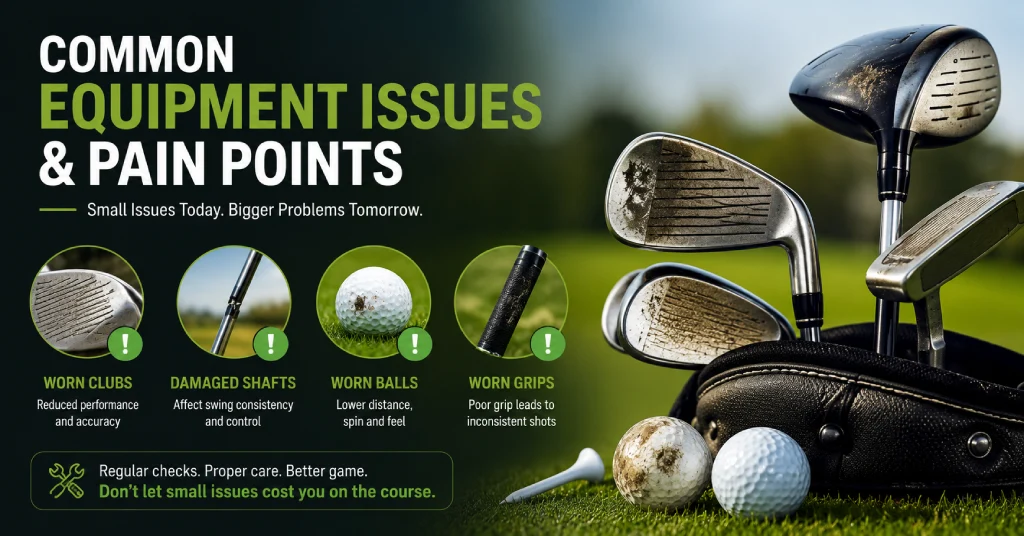
After years of fitting golfers across all skill levels, one thing stands out above everything else: the problems are remarkably consistent. The handicaps are different, the swings are different, but the frustrations? Almost identical.

Walk into any golf club in the world and ask a random group of golfers what they struggle with. You will hear the same answers every time. The slice off the tee. The 3-wood that refuses to get airborne. The long irons that inspire dread. The chip that either bounces across the green or dies in the grass two feet in front of them. The bunker. And putting — always putting.

What is remarkable is not that these problems exist. What is remarkable is how universal they are. A 28-handicapper and a 12-handicapper will often describe the exact same frustration with the exact same club. And here is the uncomfortable truth that the golf industry rarely admits: in many of these cases, the golfer is not entirely to blame. The equipment is working against them.

The tee shot

Cannot hit the driver consistently — it always seems to slice right

I have tried everything. I aim left to compensate. I slow my swing down. I move the ball forward in my stance. Nothing works.”

What is really going on

The slice is the most common shot in amateur golf — and it is almost always blamed entirely on swing path. But equipment plays a huge role that is rarely discussed. A driver that is too long makes it nearly impossible to consistently find the centre of the face, which opens the face at impact and sends the ball right. A shaft that is too stiff for your swing speed means the face cannot square up in time. A face angle that is too open compounds both problems. Most off-the-shelf drivers are built for a theoretical average golfer — longer than most people can control, stiffer than most swings require. The slice is often not a swing problem. It is an equipment problem that has been blamed on the swing for years.
 

What fitting addresses

Correct driver length, the right shaft flex and weight for your swing speed, and a face angle matched to your natural delivery. Most golfers are genuinely surprised how quickly the slice reduces when the club stops fighting them.

The fairway wood

Cannot hit the 3-wood — it never gets up in the air

“I just cannot get it up. I skull it along the ground or hit a low screamer that goes nowhere near as far as it should.”

What is really going on

The 3-wood is statistically the most left-in-the-bag club in amateur golf, and for good reason. Standard 3-woods have very little loft — typically 15 degrees — and a long shaft that demands a precise, sweeping strike from the turf. Most club golfers have a slightly descending angle of attack, which is fine for irons but disastrous for a 3-wood off the deck. Combine that with a shaft that may be too heavy or too stiff, and the ball simply cannot get the launch it needs. Many golfers who “cannot hit a 3-wood” hit a 5-wood or a high-lofted hybrid just fine — because those clubs have the loft and shaft profile that matches how they actually swing.

What fitting addresses

Loft selection matched to your angle of attack, shaft weight and flex suited to your tempo, and often a recommendation to replace the 3-wood entirely with a higher-lofted alternative that does the same job far more reliably.

The long irons

Cannot hit the longer irons — they stay low and go nowhere

“My 7-iron is fine. The moment I pick up a 4 or 5, something goes wrong. It comes out low, thin, and well short of where it should go.”

What is really going on

Long irons are genuinely difficult clubs — even tour professionals have largely replaced them with hybrids. But for most club golfers, the problem is made significantly worse by equipment. Modern irons are manufactured with increasingly strong lofts to inflate the distance numbers on marketing materials. A “5-iron” today often has the loft of what used to be a 3-iron. That means it requires a significantly higher swing speed and more precise strike to get the ball airborne. Add to that shafts that are too heavy or too stiff for a mid-range swing speed, and the long iron becomes a genuinely unfair ask. The golfer blames themselves. The club deserves at least equal blame.

What fitting addresses

Loft verification and correction, shaft weight and flex matched to your actual swing speed, and — where appropriate — replacing low-lofted long irons with hybrids that cover the same yardage far more consistently and forgivingly.

Around the green

Cannot chip — it is either a duff or a skull every time

“I can be on the green in two and take four more to get in. I dread anything within 30 yards of the flag.”

What is really going on

Chipping anxiety is almost universal among club golfers, and it costs more shots than any other single weakness. Technique is certainly a factor — but the equipment setup is frequently overlooked. Grip size has a dramatic effect on short game feel and touch. A grip that is too thick deadens the hands and kills the feedback that chipping requires. Bounce angle on the wedge — the angle of the sole relative to the ground — needs to match both your technique and the turf conditions you play on. Too much bounce and the club skips off the turf into the ball for a skull. Too little and it digs — a duff. Most golfers have never had their wedge bounce angle assessed, yet it is one of the most direct causes of inconsistent chipping.

What fitting addresses

Grip size matched to your hands for maximum feel, wedge bounce and grind suited to your chipping style and course conditions, and shaft weight that allows the hands to stay connected to the shot.

The bunker

Cannot get out of bunkers reliably — or flies it clean over the green

“One shot I leave it in the bunker. The next I skull it 30 yards past the flag. I have no idea what is going to happen when I step in.”

What is really going on

Bunker play is the shot most golfers practise least and fear most. But the sand wedge itself is often part of the problem. Loft and bounce on a sand wedge need to match the type of sand you typically play from. Coarse, firm sand requires less bounce; fine, fluffy sand requires more. A sand wedge with the wrong bounce for the conditions will either dig too deep — leaving the ball in the bunker — or skip off the sand into the ball. Shaft length also matters: a sand wedge that is too long forces you into an upright stance that changes your angle of attack into the sand. Most golfers using stock sand wedges have never had either of these variables checked.

What fitting addresses

Sand wedge loft, bounce, and sole grind matched to the typical sand conditions you play in, alongside shaft length that promotes the right posture and angle of attack for a consistent, reliable exit.

On the green

Cannot putt consistently — always short or always long

“My distance control is all over the place. I leave myself three-putt after three-putt. I know the line — I just cannot get the pace right.”

What is really going on

Putting accounts for roughly 40% of all strokes in a round — making it the single biggest scoring opportunity most golfers leave on the table. And yet putter fitting is the most neglected fitting of all. Putter length is almost universally wrong on stock putters: too long a putter pushes the hands too high, forcing the elbows out and turning a pendulum stroke into an arc that is impossible to repeat. Loft on the putter face — yes, putters have loft — needs to match the angle at which you deliver the face at impact, or the ball skips and bounces rather than rolling end-over-end immediately. Grip size is equally critical: too thin and the hands take over, causing distance control to become guesswork. Too thick and you lose feel entirely. A putter fitting using sensor data reveals exactly what is happening at impact — and the results consistently surprise golfers who assumed their putting problems were purely mental.

What fitting addresses

Putter length, loft, lie angle, and grip size — all validated with putting sensor data that shows exactly what the face is doing at impact. Most golfers who go through a putter fitting see immediate, measurable improvement in distance control.

If you recognised yourself in two, three, or all six of the above — you are in good company. These are not unusual problems. They are the default experience of the vast majority of club golfers, playing with clubs that were designed for nobody in particular.

The good news is that none of these problems are permanent. And while lessons will always have their place, equipment that is working against you will undo a lesson just as fast as it was learned. Getting the clubs right first gives every improvement you make on the range a genuine chance of showing up on the course.

Sound familiar?

At Pin High, we see these exact six problems in almost every fitting session we conduct. The fitting process is straightforward, data-driven, and — as Titleist recommends — does not require more than 35 swings per club to arrive at clear, confident answers.

If any of the above has been a persistent part of your game, it may be worth finding out how much of it is you — and how much of it is simply the wrong equipment. More often than not, it is more of the latter than you think.


Scroll to Top